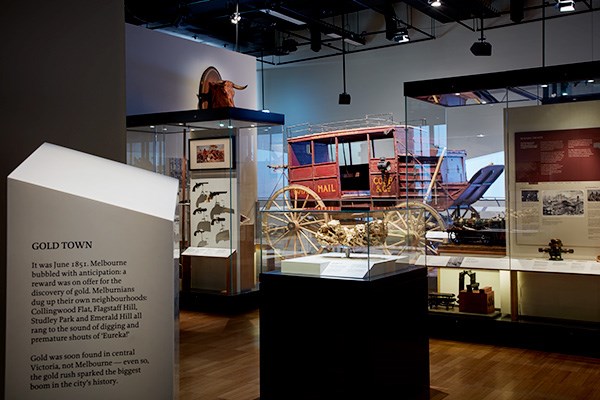
1850–1880: Gold Town
It was June 1851. Melbourne bubbled with anticipation: a reward was on offer for the discovery of gold. Melburnians dug up their own neighbourhoods: Collingwood Flat, Flagstaff Hill, Studley Park and Emerald Hill all rang to the sound of digging and premature shouts of ‘Eureka’.
Gold was soon found in central Victoria, not Melbourne—even so, the gold rush sparked the biggest boom in the city’s history.
Key Dates
1850
Melbourne’s population: 20 500
1851
Gold rush begins; in 10 years, more than half a million people arrive in Victoria
1854
National Museum of Victoria, Public Library and University of Melbourne are founded
1854
First railway and telegraph services are established
1855
Victoria passes Australia’s first immigration act, restricting Chinese immigration
1856
Building workers win an eight-hour day
1859
Seven member of the Melbourne Cricket Club codify Australian Rules Football, making it the oldest football code in the world
1860
Burke and Wills leave on their ill-fated expedition to travel across the Australian continent
1860
Nicholson Land Act aims to free up rural land for smallholders and limit ownership by wealthy squatters
1863
Coranderrk Aboriginal Station established near Healesville for the re-settlement of Aboriginal people
1870
Britain withdraws its military forces leaving Victoria responsible for its own defence
1872
Victorian Education Act establishes free, compulsory and secular education
1880
Melbourne’s population 281 000