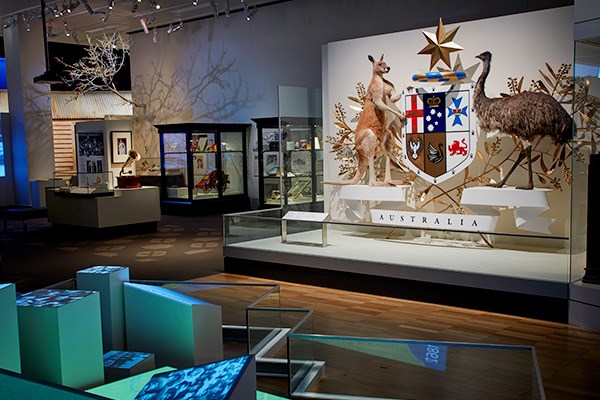
1900–1920: Melbourne and the Nation
It was the most magnificent crowd Melbourne had ever seen: 12,000 of Australia’s leading lights, dressed in their finest frock coats, uniforms and gowns, glittering with jewels, rustling in starched cotton and velvet, breathing the same air as the Duke of Cornwall and York – the future King George V.
Seated beneath the soaring dome of the Exhibition Building, they were waiting for the glorious moment: the opening of Australia’s first parliament, in Australia’s first capital city – Melbourne.
Key Dates
1900
Melbourne’s population: 494,900
1901
Sydney’s population surpasses Melbourne for the first time since 1861
1901
Melbourne becomes the temporary capital of the newly federated Australia
1901
“White Australia policy” and national import tariffs introduced
1902
Women win the right to vote in Federal elections; women are not permitted to vote in Victorian elections until 1908
1906
Release of the world’s first feature film, The Story of the Kelly Gang, made in Melbourne
1906
First suburban electric tram services introduced in Melbourne
1907
Harvester Judgement in Melbourne establishes the “living wage” for Australian men
1910
New Flinders Street Station opens
1912
Luna Park opens
1914
World War one begins; ends in 1918
1919
Worldwide influenza pandemic strikes Melbourne
1920
Melbourne’s population: 763,000
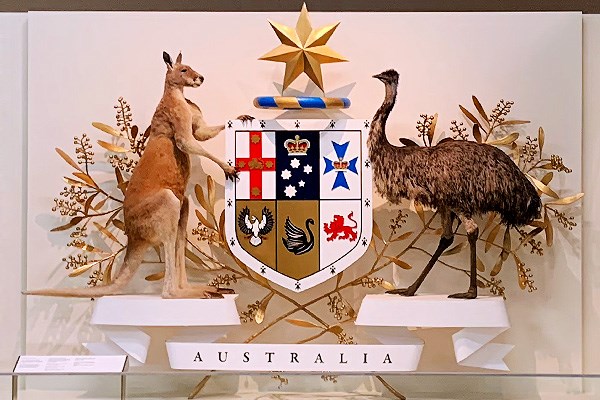
Australian coat of arms
The Australian coat of arms was granted royal warrant by King George V in 1912, when Melbourne was the capital of Australia.
The Commonwealth star sits on a blue and gold wreath (Australia’s livery colours). Its seven points represent the six states and the territories.
The shield bearing badges from each of the six states is supported by a red kangaroo and an emu. Both animals are widely accepted as Australia’s faunal emblems.
The six blazons on the shield represent the states of Australia.
Top left to right: New South Wales, Victoria, Queensland
Bottom left to right: South Australia, Western Australia, Tasmania
The shield is framed by wattle, officially adopted as Australia’s national floral emblem in 1988.
This coat of arms was made by staff at Museums Victoria, using taxidermied specimens.
Permission for Museums Victoria to reproduce the Commonwealth coat of arms granted by the Department of the Prime Minister and Cabinet.